How to Choose an AI Inference Provider for Agent Workloads
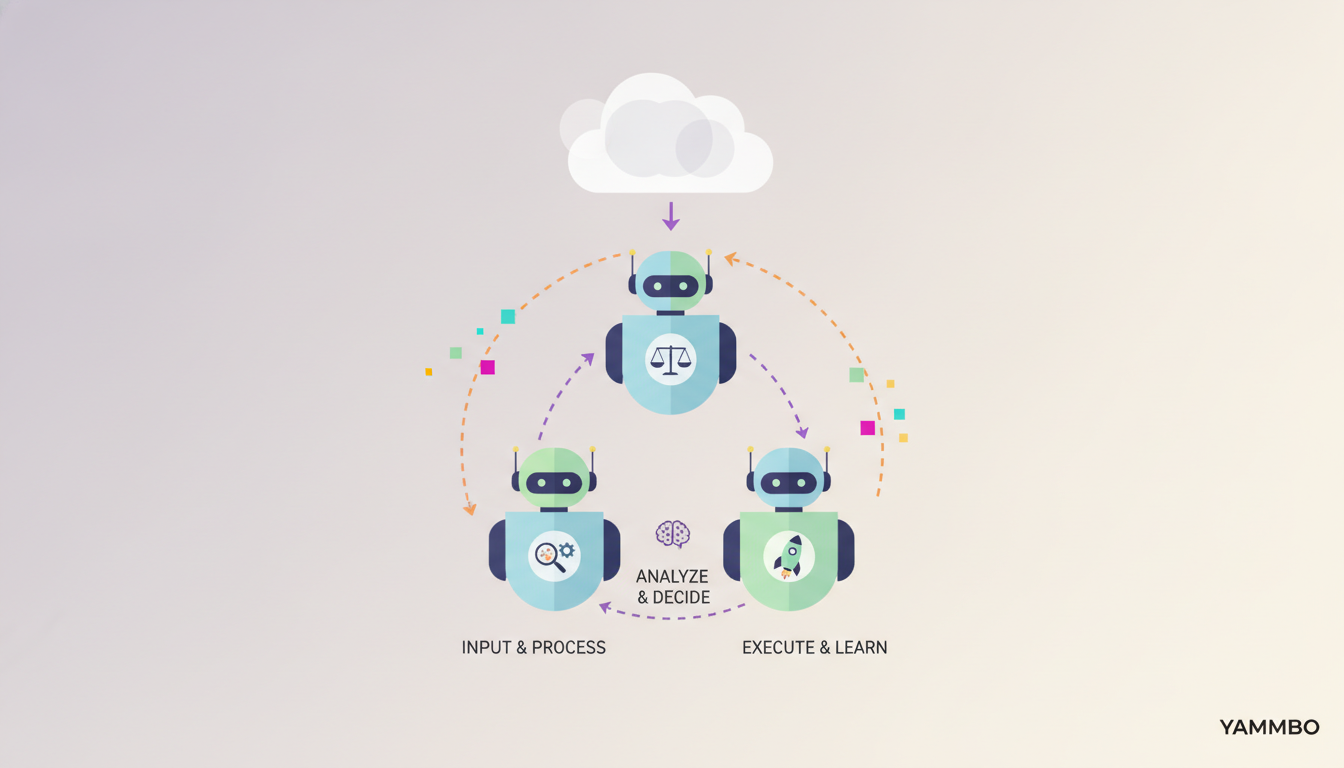
Building effective AI agents requires careful consideration of the underlying inference providers. Unlike simple chatbot interactions, agents often execute complex, multi-step workflows involving numerous sequential model calls and external tool integrations. This tutorial guides you through evaluating inference providers based on metrics crucial for agent performance and cost-efficiency, moving beyond traditional token-based comparisons to focus on the 'cost per completed task'. Understanding these nuances will help you select the best provider for your agent's unique demands.
Step 1: Understanding Agent Workflows and Latency Accumulation
When an AI agent processes a complex request, it doesn't typically make a single, monolithic call to a large language model (LLM). Instead, it orchestrates a series of smaller, sequential interactions. This workflow might involve multiple distinct steps:
- Interpret the user's request.
- Create a detailed research or action plan.
- Choose an appropriate external tool (e.g., a search engine, a calculator).
- Generate specific arguments for the selected tool.
- Interpret the results received from the tool.
- Decide whether more evidence or steps are required.
- Perform another search or tool call if necessary.
- Extract relevant facts or data points.
- Call a specialized calculator or data processor.
- Validate the calculation or processed data.
- Compose the final answer or response.
- Perform a final check on the generated response for accuracy and completeness.
Each of these steps often requires a round trip to the inference provider. The output of one step becomes the input for the next, creating a critical path where latency accumulates. For instance, if a single model call takes an extra 500 milliseconds, and your agent performs 12 such calls in sequence, the total task completion time increases by a full six seconds. This compounding effect means that small differences in per-call latency lead to significant differences in overall task duration and user experience. A provider with seemingly acceptable latency for a single query can quickly become a bottleneck for a multi-step agent.
Step 2: Prioritizing Time-to-First-Token (TTFT) and Inter-Token Latency
For interactive AI agents, two latency metrics are paramount: Time-to-First-Token (TTFT) and inter-token latency. TTFT is the duration from when your request is sent to the provider until the very first piece of the model's response arrives. Inter-token latency measures the time between consecutive output tokens. These metrics are crucial because an agent often cannot proceed with the next step in its workflow until it receives at least the initial part of the previous step's output.
While throughput, often measured in tokens per second, indicates the raw processing power of an inference system, it can be a deceptive metric for agent workloads. A provider might boast high throughput, but if its TTFT is consistently high, your agent will spend more time waiting for the initial response of each sequential step. Consider two hypothetical providers:
- Provider A: Begins responding after 300 milliseconds and generates 70 tokens per second.
- Provider B: Begins responding after 900 milliseconds and generates 130 tokens per second.
For a single, long response, Provider B might eventually deliver the full output faster. However, for an agent making many short, sequential calls, Provider A's low TTFT allows the agent to start processing the next step much sooner, leading to faster overall task completion. For an agent, getting the first token quickly to proceed to the next step is often more valuable than receiving the entire (potentially large) response faster later on. Prioritizing low TTFT is essential for minimizing the cumulative wait time across an agent's trajectory.
Step 3: Evaluating Tool Calling Reliability
AI agents frequently extend their capabilities by calling external tools or functions. This process typically involves the LLM generating arguments for an API call, which your application then executes. The reliability of this entire process is critical for an agent's success and efficiency.
A robust inference provider will consistently generate correctly formatted arguments for tools and accurately interpret their outputs. Common issues that can arise include:
- Malformed arguments (e.g., incorrect JSON structure, wrong data types).
- Incorrect tool selection (the model chooses the wrong tool for the task).
- Misinterpretation of tool results, leading to incorrect subsequent actions.
Failures in tool calling, such as malformed JSON arguments or incorrect function selection, force the agent to retry or re-plan its actions. Each retry consumes additional tokens, adds latency, and potentially incurs costs from the tool itself (if the tool call was made before the error was detected). These compounding failures significantly degrade agent performance and increase the overall cost per task. When evaluating providers, it's vital to test their consistency in generating valid tool calls across a diverse set of scenarios, as unreliable tool calling can quickly undermine an agent's effectiveness.
Step 4: Ensuring Structured Output Guarantees
Many agent workflows depend on the LLM providing output in a specific, structured format—for example, a JSON object representing a plan, a list of facts, or a set of tool arguments. If the model's output deviates from the expected schema, your agent's parsing logic will fail, necessitating error handling, retries, and additional model calls. This adds complexity to your agent's code and introduces further latency and cost.
Some inference providers offer features like 'JSON mode' or enforce specific output schemas, guaranteeing that the model's response will conform to a valid structure. This significantly reduces the overhead of validation and error correction in your agent's code, making the entire workflow more robust and efficient. For example, if your agent expects a JSON array of objects, a provider with structured output guarantees will ensure the response is always valid JSON and adheres to the specified array and object structure. Without such guarantees, your agent might spend valuable cycles trying to repair malformed outputs, adding to both latency and cost. Prioritizing providers that offer strong structured output guarantees can dramatically improve the reliability and performance of your agent's parsing and subsequent actions.
Step 5: Calculating Cost Per Completed Task
Given the sequential nature of agent workflows, the accumulation of latency, and the potential for tool-calling and structured-output failures, the most accurate economic metric for evaluating inference providers is the 'cost per completed task'. This metric moves beyond the simplistic 'price per token' to capture the true economic efficiency of a provider for your agent's specific workload.
The cost per completed task accounts for all expenditures associated with a single, successful agent operation, including:
- All LLM inference costs, encompassing initial calls, any necessary retries, and re-planning steps due to failures.
- Costs associated with external tool calls, if applicable, which might include API fees or compute costs for external services.
- Any additional compute or network overhead incurred by your orchestration layer during the agent's execution.
By focusing on the cost of a successfully completed task, you gain a holistic view of a provider's true efficiency for your agent workload. A provider with a seemingly lower per-token price might end up being more expensive per task if it frequently requires retries due to poor tool-calling reliability or inconsistent structured output. Conversely, a provider with a slightly higher per-token price but superior reliability and lower latency might offer a significantly lower cost per completed task.
To calculate this, you would track the total spend over a period for a specific agent workflow and divide it by the number of tasks successfully completed within that same period. This provides a clear, actionable metric for comparing providers and optimizing your agent's operational costs.
Choosing the right inference provider for your AI agents goes beyond simple token pricing or raw throughput. By focusing on critical metrics like time-to-first-token, tool calling reliability, structured output guarantees, and ultimately, the cost per completed task, you can build more efficient, robust, and cost-effective AI agents. Understanding these nuances ensures your agents deliver optimal performance and value. For developers looking to build powerful web applications, Yammbo Web provides an AI-powered website builder at https://web.yammbo.com.