How to Calculate the True Cost of Your Production AI Application
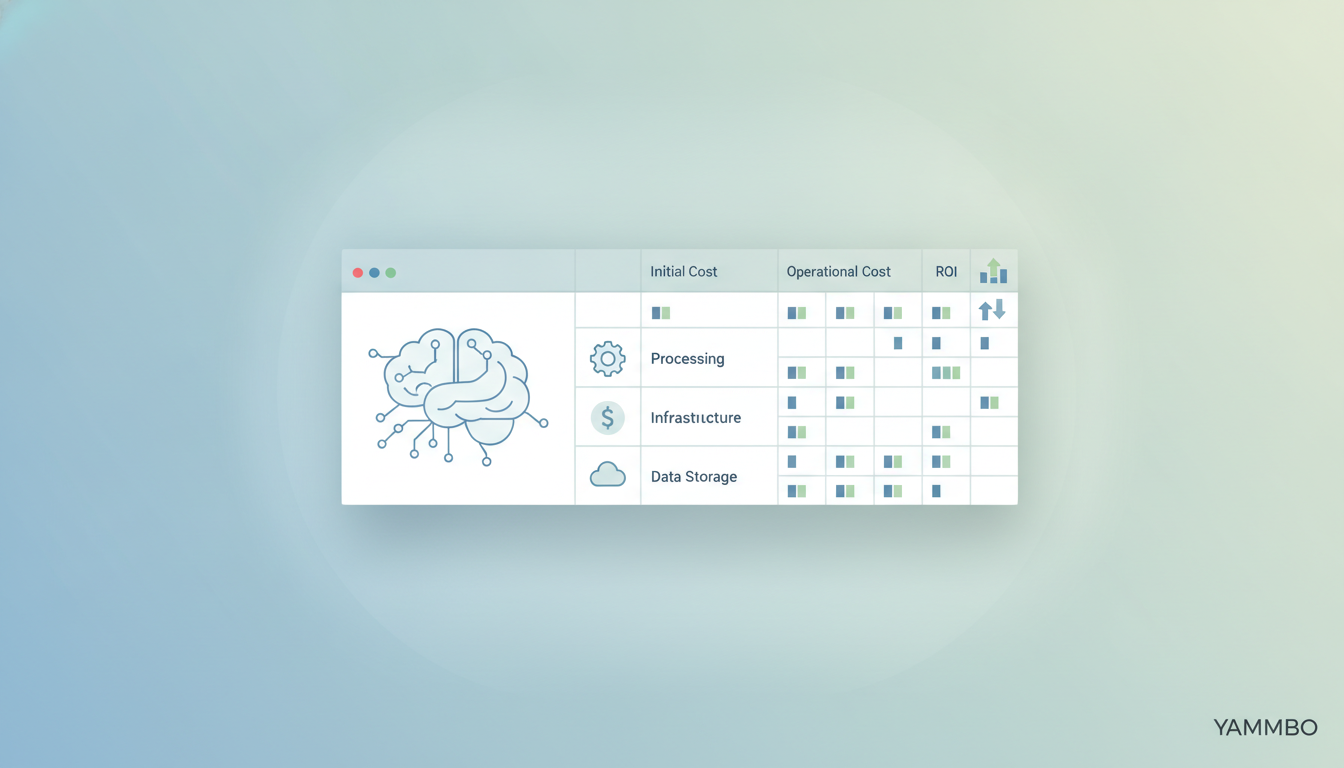
Developing and deploying an AI application in production involves more than just the cost of calling a large language model (LLM). While token pricing is a crucial element, it represents only one line item in a broader financial picture. Understanding the true Total Cost of Ownership (TCO) requires a comprehensive look at your entire application stack, from infrastructure to operational overhead. This tutorial will guide you through deconstructing these costs, helping you build a more accurate financial model for your production AI workloads.
Step 1: Deconstruct the AI Application Stack
Before diving into specific costs, it's essential to understand all the components that make up a typical production AI application. Beyond the LLM itself, several interconnected services contribute to its functionality and, consequently, its cost. Identifying these components is the first step in building an accurate TCO model.
A common AI application stack might include:
- Large Language Model (LLM) Inference: This is the direct cost associated with sending prompts to and receiving responses from an LLM, typically measured in tokens.
- Backend Compute: The servers, virtual machines, or serverless functions that host your application logic, handle user requests, orchestrate LLM calls, and process data.
- Vector Databases: Specialized databases designed to store and query high-dimensional vector embeddings, crucial for retrieval-augmented generation (RAG) applications.
- Object Storage: Used for storing large unstructured data, such as documents, images, or pre-computed embeddings, that your AI application might access.
- Networking: Data transfer costs, especially egress (data leaving a cloud provider's network), can become significant when moving data between different services or providers.
- Container Orchestration: Services like Kubernetes or managed container platforms that manage the deployment, scaling, and operation of your application's microservices.
- Observability: Tools and services for logging, monitoring, and tracing your application's performance, health, and usage patterns.
- Engineering Hours: The human cost involved in designing, developing, deploying, maintaining, and optimizing the entire stack, including managing billing relationships across multiple platforms.
Verification: Create a diagram or a simple list of every service your application relies on, even if it seems minor. This visual representation will be invaluable for the subsequent cost analysis.
Step 2: Calculate Your LLM Inference Costs
The cost of interacting with large language models is often the most visible expense, but it's crucial to understand how it's calculated and how to estimate it accurately for your specific use case. LLM providers typically charge based on the number of tokens processed, differentiating between input (prompt) and output (completion) tokens.
To estimate your inference costs:
- Identify your LLM provider(s): Different providers have varying pricing structures and model offerings.
- Determine the models you'll use: Larger or more capable models generally cost more per token. Consider if a smaller, more specialized model could suffice for certain tasks.
- Estimate average token usage per interaction:
- Input tokens: Consider the average length of user prompts, system instructions, and any context provided (e.g., retrieved documents in a RAG system).
- Output tokens: Estimate the average length of the model's responses.
- Project your application's usage volume: Estimate the number of interactions (API calls) your application will handle per month or per day. For instance, 100,000 interactions per month.
- Consult current pricing pages: LLM pricing can change rapidly. Always refer to the official pricing documentation of your chosen provider for the most up-to-date rates. For example, a provider might charge $0.50 per million input tokens and $0.75 per million output tokens.
Calculation Example:
If you have 100,000 interactions per month, with 500 input tokens and 200 output tokens per interaction:
Input tokens: 100,000 * 500 = 50,000,000 tokens
Output tokens: 100,000 * 200 = 20,000,000 tokens
Cost (at example rates): (50,000,000 / 1,000,000) * $0.50 + (20,000,000 / 1,000,000) * $0.75 = 50 * $0.50 + 20 * $0.75 = $25 + $15 = $40 per month.
Verification: Ensure your token estimates are realistic by testing your application with typical inputs and outputs. Pay attention to how context windows are managed, as larger contexts consume more input tokens.
Step 3: Account for Infrastructure and Operational Overhead
Beyond the direct LLM inference costs, a significant portion of your TCO will come from the underlying infrastructure and the effort required to operate it. These "non-inference" costs are often overlooked in initial estimates but can quickly accumulate, especially as your application scales or becomes more complex.
Key areas to consider:
- Backend Compute Costs:
- Virtual Machines (VMs) or Containers: The cost of running servers for your application logic, API gateways, and other services. This includes CPU, memory, and storage provisioned.
- Serverless Functions: While often cheaper for intermittent workloads, serverless compute still incurs costs based on invocations, duration, and memory usage.
- Data Storage Costs:
- Vector Database Storage: The cost of storing vector embeddings and associated metadata. This can scale significantly with the size of your knowledge base for RAG applications.
- Object Storage: Storing documents, media files, and other large assets. Costs are usually per GB per month, plus data access charges.
- Networking Costs:
- Data Egress: This is often the most surprising cost. When data moves out of a cloud provider's network or even between different regions/availability zones within the same provider, you are typically charged. If your LLM provider is different from your backend compute provider, data egress between them can become substantial.
- Load Balancers and API Gateways: These services manage traffic to your application and incur their own costs based on throughput and connections.
- Observability and Monitoring:
- Logging Services: Storing and querying application logs. Costs are often based on data ingestion volume and retention period.
- Monitoring Tools: Services for collecting metrics, setting up alerts, and visualizing application performance.
- Tracing Systems: For distributed applications, tracing helps understand request flows but adds to data ingestion and storage costs.
- Container Orchestration and Management:
- If you use Kubernetes, there are costs associated with the control plane and worker nodes. Managed Kubernetes services simplify operations but have their own pricing models.
- Engineering Hours:
- The time spent by your team integrating different services, managing infrastructure, debugging issues, and optimizing performance. While not a direct cloud bill line item, it's a significant TCO component.
- Managing billing relationships across multiple cloud providers can also consume considerable engineering and administrative time.
Verification: Review your current cloud provider bills (if applicable) for non-LLM services. Identify any services that are consistently growing in cost and investigate their usage patterns.
Step 4: Evaluate Architectural Impact on TCO
The way you design and deploy your AI application has a profound impact on its total cost. Different architectural patterns can lead to vastly different expense profiles, particularly concerning the balance between inference costs and the surrounding infrastructure and operational overhead.
Consider these architectural approaches:
- Consolidated Single-Provider Architecture:
- Description: All major components of your AI application (backend compute, vector database, object storage, and LLM inference) are hosted within the same cloud provider's ecosystem.
- Cost Implications: This approach often leads to lower TCO due to reduced data egress charges (data stays within the same network) and simplified operational overhead. Managing a single billing relationship and a unified set of tools can save significant engineering time. For simpler applications like a Retrieval-Augmented Generation (RAG) system, inference might indeed be the majority of the bill, as other costs are minimized.
- Benefit: Less complexity, potentially lower networking costs, streamlined billing.
- Multi-Provider or Distributed Architecture:
- Description: Your application components are spread across multiple cloud providers or specialized vendors. For example, your backend compute might be on one provider, your vector database on another, and your LLM inference on a third.
- Cost Implications: While this offers flexibility and potentially access to best-of-breed services, it significantly increases complexity and often TCO. Data egress charges become a major concern as data frequently moves between different networks. Operational overhead for managing multiple vendor relationships, different APIs, and disparate monitoring systems can consume a large portion of engineering resources. In such setups, non-inference costs can easily outweigh inference costs.
- Drawback: Increased data egress costs, higher operational complexity, fragmented billing.
The choice between these architectures depends on your specific needs regarding vendor lock-in, specialized features, and team expertise. However, for most teams building complete AI applications, consolidating services where possible can offer substantial cost advantages by minimizing the "hidden" expenses that don't appear in a per-token comparison.
Verification: Map out the data flow between all your application components. For every connection, identify if data is crossing network boundaries (e.g., between cloud providers, regions, or even different services within the same provider) and estimate the volume of data transferred.
Step 5: Optimize for Cost-Efficiency
Once you have a clear understanding of your AI application's cost components, you can implement strategies to optimize expenses without sacrificing performance or reliability. Strategic choices in infrastructure, model usage, and operational practices can lead to significant savings.
- Embrace Serverless as a Default:
- For many AI application backends and orchestration layers, serverless functions (like AWS Lambda, Azure Functions, Google Cloud Functions) are an excellent starting point. They automatically scale with demand and you only pay for actual usage, eliminating idle capacity costs.
- When to reconsider: Move to dedicated virtual machines or reserved GPU instances only when your application reaches consistent, high utilization where the cost per unit of compute consistently beats serverless pricing, or if specific performance requirements (e.g., extremely low latency) necessitate dedicated resources.
- Leverage Batch Processing for Latency-Tolerant Workloads:
- If your application has tasks that don't require immediate LLM responses (e.g., content generation for newsletters, data summarization, large-scale analysis), consider using batch inference. Many LLM providers offer significant discounts (sometimes up to 50% or more) for batch jobs, as they can optimize resource allocation.
- Identify parts of your application where synchronous, real-time responses are not critical and refactor them for asynchronous, batched processing.
- Right-Size Your LLM and Model Usage:
- Choose the appropriate model: Don't always default to the largest, most capable LLM. For simpler tasks like classification, summarization, or specific data extraction, smaller, more cost-effective models might perform just as well.
- Fine-tuning vs. Prompt Engineering: Sometimes, a well-engineered prompt with a smaller model can outperform a generic prompt with a larger, more expensive model. Explore prompt optimization techniques.
- Caching: Implement caching for common LLM queries or frequently accessed embeddings to reduce redundant API calls and database lookups.
- Minimize Data Transfer Costs (Egress):
- Consolidate Services: As discussed, keeping your application components within the same cloud provider and region significantly reduces egress charges.
- Compress Data: Before transferring large datasets, ensure they are compressed to reduce the volume of data moved.
- Optimize Data Access: Retrieve only the necessary data from databases and storage to minimize transfer volumes.
- Build Your Own Bottom-Up TCO Model:
- The most critical step is to create a detailed spreadsheet or tool that itemizes all the costs identified in this tutorial for your specific application.
- Don't rely solely on vendor-provided TCO calculators, as they often highlight their strengths and obscure weaknesses.
- Include every line item: LLM inference (input/output tokens), compute (VMs/serverless), storage (vector DB, object storage), networking (egress), observability, and an estimate for engineering effort.
- Regularly review and update this model as your application evolves and as provider pricing changes. This allows you to identify cost drivers and make informed decisions.
Verification: Regularly monitor your cloud spending dashboards. Set up alerts for unexpected cost spikes and conduct quarterly reviews of your TCO model against actual expenditure. Look for opportunities to apply the optimization strategies outlined here.
Understanding the true cost of a production AI application requires moving beyond simple token price comparisons. By systematically deconstructing your entire application stack, accounting for all infrastructure and operational overhead, and evaluating architectural choices, you can build a comprehensive Total Cost of Ownership model. This holistic view empowers you to make informed decisions, optimize your spending, and ensure the long-term financial viability of your AI initiatives. To learn more about building robust online presences, visit Yammbo.