How to Build an Efficient Graph-Based RAG System
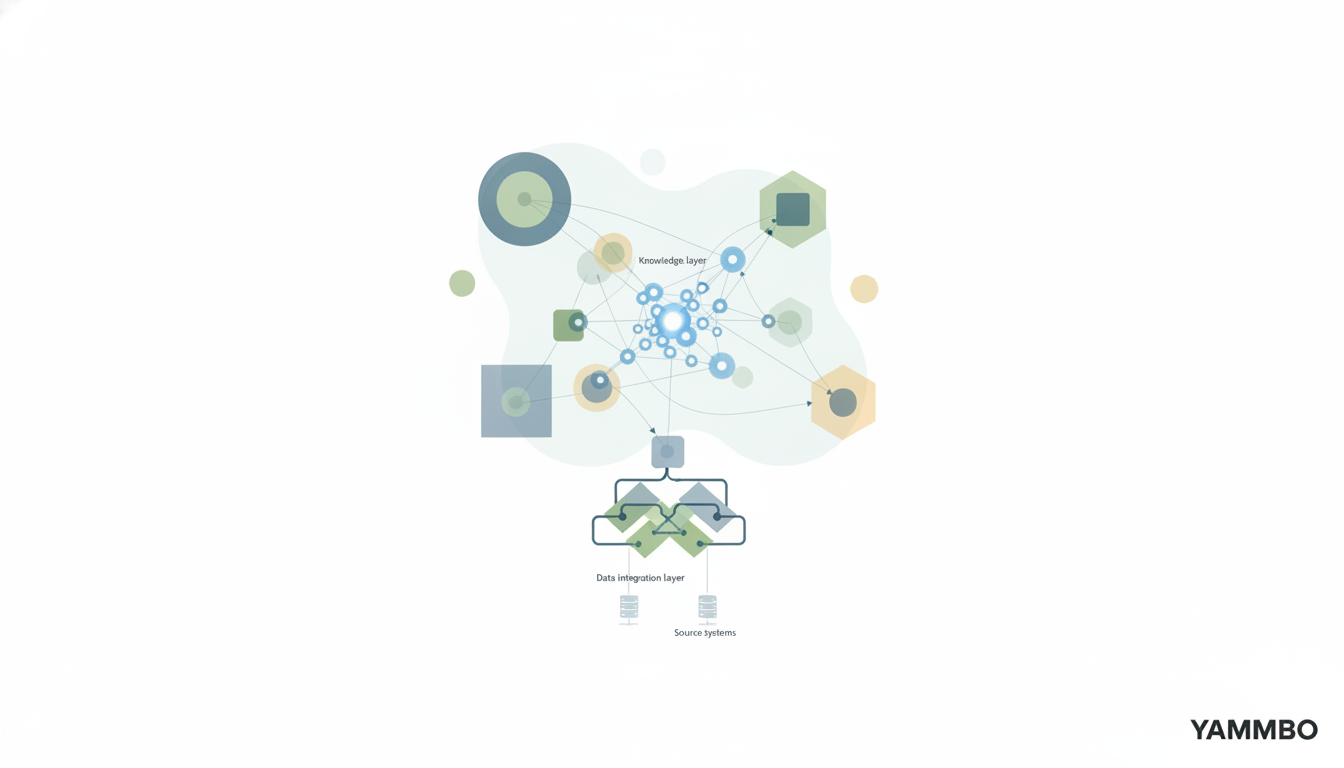
Building a robust Retrieval Augmented Generation (RAG) system is crucial for enabling large language models (LLMs) to access and synthesize up-to-date, domain-specific information. While traditional vector-based RAG excels at retrieving similar text chunks, it often struggles with questions requiring an understanding of interconnected concepts across multiple documents. This is where GraphRAG shines, transforming unstructured text into a knowledge graph to facilitate complex reasoning. For a deeper understanding of the foundational RAG concept, you can refer to Retrieval Augmented Generation on Wikipedia.
However, the true challenge and cost driver in implementing GraphRAG isn't primarily the choice of a graph database. Instead, it lies in optimizing the extensive LLM inference workload involved in building and querying the graph. This tutorial will guide you through architecting an efficient GraphRAG system, focusing on the critical steps of entity extraction, graph construction, and inference optimization to manage costs and latency effectively.
Understanding GraphRAG Fundamentals
GraphRAG extends the capabilities of standard RAG by representing information as a structured knowledge graph rather than just a collection of text embeddings. In a typical vector RAG setup, text chunks are embedded, and queries retrieve the most similar chunks based on vector distance. This approach is effective for "what does this document say" types of questions but lacks the ability to infer relationships or synthesize information across disparate documents.
GraphRAG introduces a multi-stage pipeline that fundamentally changes how knowledge is indexed and retrieved. At its core, an LLM processes text to identify entities (e.g., people, organizations, concepts) and the relationships between them, forming structured triples like "(Company A) acquired (Company B)." These triples are then stored in a graph database, creating a network of interconnected information.
Beyond simple entity-relationship extraction, advanced GraphRAG implementations often involve further LLM passes. For instance, community detection algorithms, such as the Leiden algorithm, can be applied to group densely connected entities into clusters. Subsequently, LLMs summarize these communities, sometimes recursively to form a hierarchical understanding of the corpus. This intricate indexing process, involving multiple LLM calls per document, is what makes GraphRAG powerful for multi-hop reasoning and contextual summarization, but also significantly more resource-intensive than vector RAG.
Step 1: Designing Your Entity Extraction Pipeline
The first critical phase in building a GraphRAG system is extracting entities and relationships from your raw text data. This step is entirely dependent on LLM inference and directly dictates the initial cost and latency of your indexing pipeline. A well-designed extraction pipeline balances accuracy with efficiency.
Your primary decision here involves selecting the LLM strategy for this task:
- Metered Frontier APIs: Services like OpenAI or Anthropic offer highly capable LLMs that can extract entities and relationships with high accuracy. This option typically requires less operational overhead but comes with per-token usage costs that can quickly accumulate when processing large corpora.
- Self-Hosted Models: Deploying smaller, open-source LLMs (e.g., from the Llama or Mistral families) on your own infrastructure provides greater control over costs and latency. This approach requires more technical expertise for deployment and management, and potentially fine-tuning the model for your specific domain and extraction schema.
Regardless of your choice, the process involves prompting the LLM to identify specific entities and the relationships between them, outputting them in a structured format, often as triples. For example, given a support ticket, an LLM might extract:
(Customer, reported, Issue)(Issue, affects, Product)(Customer, uses, Service)Verification: To ensure the quality of your extraction, evaluate a sample of the LLM's output. Check for:
- Accuracy: Are the extracted entities and relationships correct and relevant?
- Completeness: Is the LLM capturing all important entities and relationships?
- Consistency: Are entities and relationships named consistently across different documents?
Iterate on your prompts or model choice until you achieve a satisfactory balance between extraction quality and inference cost.
Step 2: Constructing and Enriching the Knowledge Graph
Once entities and relationships are extracted, the next step is to store them in a graph database and enrich the graph structure. This forms the foundation for advanced querying and reasoning capabilities.
A graph database is optimized for storing and querying highly interconnected data. While the specific choice of database (e.g., Neo4j, FalkorDB, or a simpler RDF store) might seem important, its performance impact is often secondary to the LLM inference costs. The key is its ability to efficiently store and traverse nodes (entities) and edges (relationships).
Populating the graph involves taking the structured triples from Step 1 and inserting them into your chosen graph database. Each unique entity becomes a node, and each relationship becomes a directed edge between two nodes. For instance, the triple (Company X, acquired, Company Y) would create two nodes (Company X, Company Y) and an edge "acquired" from Company X to Company Y.
Further enrichment often involves:
- Community Detection: Applying algorithms to identify groups of densely connected entities. These communities represent broader topics or clusters of related information. For example, a graph built from customer support tickets might reveal communities around "billing issues," "product features," or "account management."
- Community Summarization: Using another LLM pass to generate natural language summaries for each identified community. These summaries provide a high-level overview of the information contained within a cluster of entities, making global search more efficient. This step can be recursive, summarizing communities of communities to build a hierarchical understanding.
Verification: After construction, perform sanity checks:
- Graph Visualization: Use graph visualization tools to inspect a subset of your graph. Are entities correctly connected?
- Community Review: Examine the entities within a few detected communities. Do they logically belong together? Review the LLM-generated summaries for accuracy and coherence.
- Basic Queries: Run simple graph traversals to ensure data integrity and connectivity.
Step 3: Optimizing LLM Inference for Graph Indexing
The multi-stage indexing process of GraphRAG, particularly the entity extraction and community summarization steps, can involve tens of thousands of LLM calls for a moderately sized corpus. This makes LLM inference optimization the single most impactful factor for managing the cost and speed of your GraphRAG system.
Consider these strategies to optimize your inference pipeline:
- Batching LLM Requests: Group multiple independent prompts into a single API call to reduce overhead and improve throughput. Many LLM APIs support this, and it's a fundamental optimization for self-hosted models.
- Caching LLM Responses: Implement a caching layer for LLM outputs. If the same or a very similar prompt is sent multiple times (e.g., for common entities or boilerplate text), a cached response can prevent redundant LLM calls.
- Parallel Processing: Distribute the LLM inference workload across multiple workers or machines. This is especially effective when processing a large corpus, allowing many documents or chunks to be processed concurrently.
- Model Specialization: Instead of using one large general-purpose LLM for all tasks, consider using smaller, fine-tuned models for specific sub-tasks. For instance, a highly specialized model might be more efficient and cheaper for just entity extraction, while a different model handles summarization.
- Hardware Acceleration: For self-hosted models, leverage GPUs or other accelerators to speed up inference. Quantization and model pruning techniques can also reduce the computational requirements of your models without significant performance degradation.
- Prompt Engineering: Optimize your prompts to be concise and clear, reducing token usage and improving the LLM's ability to provide the desired output efficiently.
Verification: Continuously monitor the performance and cost metrics of your LLM inference pipeline. Track:
- API Costs: If using metered APIs, track your spending per document indexed.
- Indexing Latency: Measure the time it takes to process a document or a batch of documents through the entire LLM inference pipeline.
- Throughput: How many documents can your system process per unit of time?
These metrics will highlight bottlenecks and inform further optimization efforts.
Step 4: Implementing Effective Querying Strategies
The true power of GraphRAG is realized through its ability to answer complex queries that traditional vector RAG cannot. Effective querying strategies leverage both the global context provided by community summaries and the granular detail of entity relationships.
GraphRAG excels at several types of queries:
- Multi-hop Reasoning: Questions that require traversing multiple relationships in the graph (e.g., "What products are affected by issues reported by customers who use Service X?").
- Contextual Summarization: Questions that require synthesizing information spread across many documents by connecting related entities (e.g., "Summarize all known interactions between Company A and Company B regarding Product Z.").
- Aggregation Queries: Questions that involve counting or grouping entities based on their relationships (e.g., "How many customers reported issues related to Feature Y this month?").
Your querying mechanism should be designed to utilize the graph structure. This can involve:
- Global Search via Community Summaries: For broad or high-level questions, the system can first query the LLM-generated summaries of communities (from Step 2). This provides a quick way to narrow down the relevant parts of the knowledge graph.
- Local Search via Entity Traversal: For specific, multi-hop questions, the system performs graph traversals, starting from an initial entity and following relationships to discover connected information. This often involves a query language specific to your graph database (e.g., Cypher for Neo4j, Gremlin for Apache TinkerPop-compatible databases).
- Hybrid Approaches: Combining graph traversal with vector search. For instance, after identifying relevant entities via graph traversal, their associated text chunks (or summaries) could be retrieved using vector similarity for final LLM context.
Verification: Test your GraphRAG system with a diverse set of queries, including those that challenge its multi-hop reasoning and summarization capabilities. Compare the answers against a ground truth or expert judgment to evaluate:
- Answer Accuracy: Is the information provided correct?
- Completeness: Does the answer cover all relevant aspects of the query?
- Relevance: Is the information directly pertinent to the question asked?
The ability to answer these complex questions effectively is the ultimate validation of your GraphRAG architecture.
Building an efficient GraphRAG system fundamentally shifts the focus from merely selecting a database to meticulously optimizing the LLM inference stack. By carefully designing your entity extraction, graph construction, and query mechanisms, and by implementing robust inference optimization strategies, you can unlock the full potential of GraphRAG to answer complex, interconnected questions while managing operational costs. For developers looking to build robust web applications that can integrate with advanced AI capabilities, explore the tools available at Yammbo Web.