How to Build a Real-Time AI Customer Support Agent with Fallback Routing
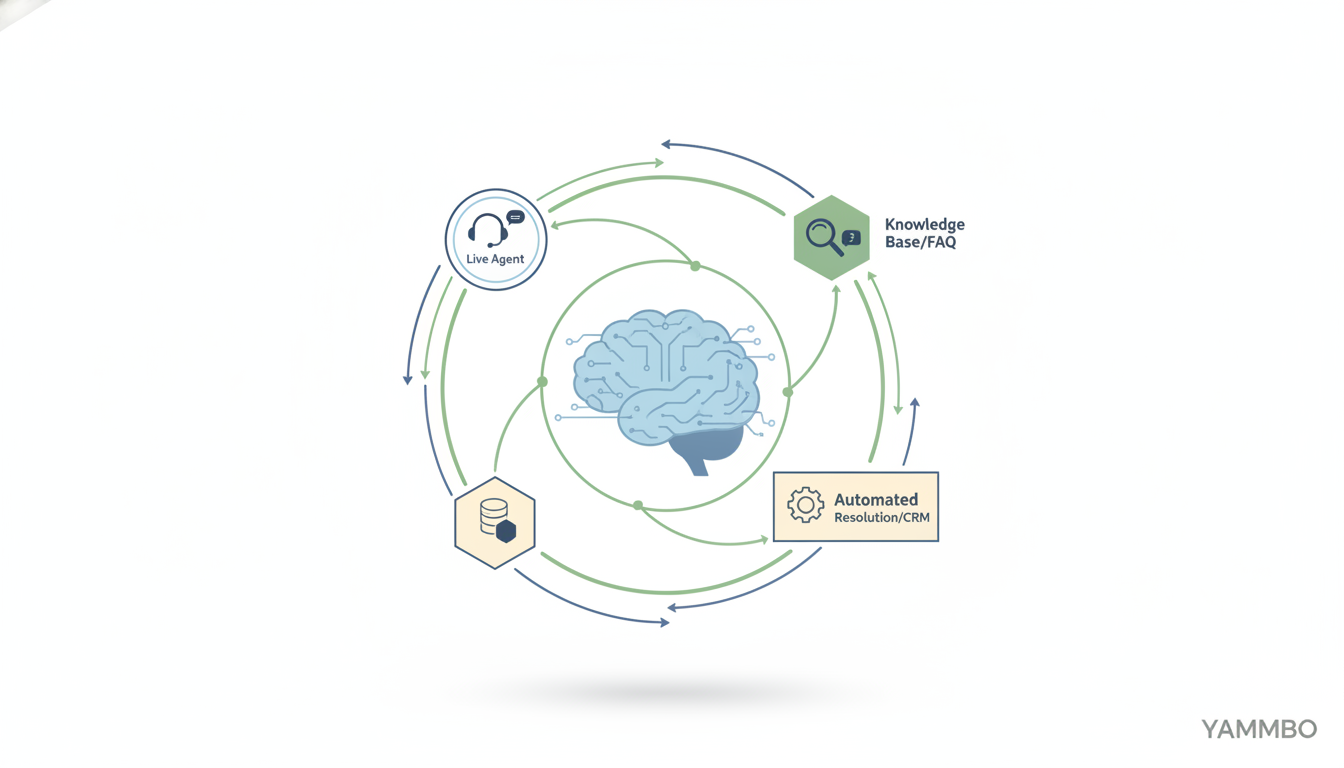
Building an effective AI customer support agent presents a significant challenge: how do you balance the need for fast, cost-efficient responses with the imperative for accuracy and appropriate handling of complex or sensitive issues? Relying solely on a single, inexpensive model might lead to errors or inadequate responses for nuanced queries, while using a powerful, expensive model for every interaction can quickly become cost-prohibitive and introduce latency. This tutorial will guide you through designing and implementing a real-time AI customer support agent that leverages fallback routing to intelligently manage these trade-offs, ensuring optimal performance and customer satisfaction.
Step 1: Understand the Core Principles of Fallback Routing
Fallback routing is an AI orchestration pattern designed to optimize the balance between speed, cost, and answer quality in automated systems. In a customer support context, it means that an incoming customer request is first directed to a primary AI model, typically chosen for its speed and cost-effectiveness. The response from this model is then evaluated against a set of predefined criteria. If the primary model's answer meets the established confidence, safety, and policy thresholds, it is delivered to the customer. If not, the request is 'fallbacked' or routed to a more capable resource—which could be a stronger AI model, a specialized AI agent, or even a human support agent—for further processing.
This approach is particularly valuable for customer support because workloads are often highly imbalanced. A large percentage of customer inquiries are repetitive and straightforward, making them ideal for a lightweight, fast AI model. However, a smaller but critical percentage requires advanced reasoning, precise instruction following, a more empathetic tone, or access to specialized tools and knowledge bases. The fallback mechanism ensures that these more complex or sensitive cases receive the appropriate level of attention without incurring the cost of using high-tier models for every interaction.
Key signals that can trigger a fallback include:
- Low confidence score: The primary model indicates uncertainty about its answer.
- Missing or incomplete answer: The response does not fully address the user's query.
- Customer frustration: Sentiment analysis detects negative user sentiment.
- Sensitive topic: Keywords or intent analysis identifies a high-risk or emotionally charged subject.
- High-value customer: The customer's profile flags them for prioritized, higher-tier support.
- Complex technical issue: The query requires deep technical knowledge or troubleshooting.
- Policy uncertainty: The primary model's response might conflict with company policy.
- Failed knowledge-base retrieval: The primary model could not find relevant information.
- Contradictory information: The AI's response contradicts previous interactions or known facts.
- Repeated user dissatisfaction: The customer has previously expressed unhappiness with AI responses.
The fallback router acts as the central traffic controller of your AI support system, making real-time decisions about which resource should handle each request, when escalation is necessary, and how to manage the operational cost of the system.
Step 2: Design the Agent's Architectural Components
A robust real-time AI customer support agent with fallback routing is composed of several interconnected modules. Understanding each component is crucial for effective design and implementation.
- Customer Input Channels: This is where customers initiate their queries. It could be a live chat widget on a website, an email inbox, a WhatsApp integration, a mobile app interface, or a help desk software portal. The system must be able to receive messages from various sources and normalize them for processing.
- Orchestration Layer (The Router): This is the brain of the fallback system. The router receives the customer's message, analyzes it, and based on predefined rules, confidence scores, and priority settings, decides which AI model or workflow should process the request. It also manages the flow of information between different models and ultimately delivers the final response back to the customer.
- Primary AI Model: This is typically a fast, cost-effective Large Language Model (LLM) or a domain-specific chatbot designed to handle a high volume of common, repetitive queries. Its goal is to provide quick, accurate answers to straightforward questions.
- Evaluation Module: After the primary AI model generates a response, this module assesses its quality. It uses various techniques to determine the confidence level, completeness, safety, and relevance of the answer. This module is critical for deciding whether to proceed with the primary response or trigger a fallback.
- Fallback Models/Workflows: These are the alternative resources activated when the primary model's response is deemed insufficient. They can include:
- Stronger General AI Model: A more powerful, often more expensive, LLM capable of complex reasoning and nuanced understanding.
- Specialist AI Model: An AI model specifically trained on a particular domain (e.g., technical support, billing, legal queries) with deep knowledge in that area.
- Human Handover: A mechanism to seamlessly transfer the conversation, along with its context, to a human support agent.
- Knowledge Base Lookup: A dedicated retrieval-augmented generation (RAG) system that queries an internal knowledge base for definitive answers.
- External Tools and APIs: For many customer support scenarios, the AI agent needs to interact with external systems. This includes integrations with CRM platforms to fetch customer history, order management systems to check order status, or internal databases for product information. The router orchestrates these interactions.
By modularizing the system in this way, you create a flexible and scalable architecture that can adapt to evolving customer needs and technological advancements.
Step 3: Implement Confidence Scoring and Evaluation
The effectiveness of a fallback routing system hinges on its ability to accurately evaluate the primary AI model's response. This evaluation is primarily driven by confidence scoring, which determines if an answer is